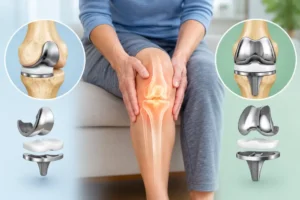
When a patient is told they need a knee replacement, most picture a single operation with a single answer. In reality, the knee is made up of three separate compartments, and arthritis does not always affect all of them.
There is the inner compartment (medial), where the thigh bone meets the shin bone on the side nearest your other leg. There is the outer compartment (lateral). And there is the kneecap compartment (patellofemoral), where the kneecap glides on the front of the thigh bone.
In a large proportion of arthritic knees — and particularly in patients whose legs have gradually bowed outwards over the years — the damage is concentrated in the inner compartment alone. The other two compartments still have healthy cartilage and intact ligaments. In that situation, replacing the whole joint means removing a great deal of bone and cartilage that was doing no harm at all.
That is the case for a partial knee replacement.
A partial knee replacement — surgeons call it a unicompartmental knee replacement — resurfaces only the worn compartment. The healthy cartilage is left alone, and crucially, both cruciate ligaments are preserved. Those ligaments are what give your knee its natural sense of position and control. In a total knee replacement, at least one of them is removed.
Preserving them is why patients who have had a partial replacement so often describe the knee as feeling like their own. It is one of the most consistent things I hear at follow-up.
The practical differences follow from that:
None of this makes a partial replacement a lesser operation. It is a technically demanding procedure with much less margin for error in implant positioning, which is precisely why outcomes vary so much between surgeons and why the number a surgeon performs each year matters.
| The short version: a partial replacement is not a smaller version of a total replacement. It is a different operation for a different pattern of arthritis. |
The decision is made from your examination and your weight-bearing X-rays, not from a scan report alone. Broadly, a partial replacement suits you if:
Two myths get in the way of this conversation more than any others.
The first is that you must be young for a partial replacement. That is out of date. Age on its own is not a disqualifier in either direction; the pattern of disease is what matters. I have performed partial replacements on patients in their seventies whose arthritis was confined to one compartment, and total replacements on patients in their fifties whose whole joint was involved.
The second is that being overweight rules it out. Modern registry data no longer supports a strict weight cut-off for partial replacement. Weight does affect your overall surgical risk and your recovery, and reducing it before surgery genuinely helps — but it is not, by itself, the deciding factor between the two operations.
I want to be equally clear about this, because a partial replacement done in the wrong knee is a poor outcome waiting to happen.
A total knee replacement is the right choice when arthritis involves two or three compartments, when there is inflammatory arthritis such as rheumatoid disease, when the deformity is fixed and cannot be corrected, when there is a significant fixed bend at the knee, or when the anterior cruciate ligament is gone and the knee is unstable.
It is one of the most reliable operations in all of surgery. Pain relief is excellent and durable, deformity is corrected, and the results are highly predictable in experienced hands. If your knee is a total replacement knee, you are not settling for something inferior — you are getting the operation that will serve you best.
This is the honest trade-off, and it deserves a straight answer.
Partial replacements have a somewhat higher revision rate than total replacements over fifteen to twenty years. Part of that reflects genuine wear or arthritis progressing into the other compartments; part of it reflects a lower threshold to revise, because converting a partial to a total is a far more straightforward operation than revising a failed total replacement.
That last point is what tips the balance for many patients. If a partial replacement gives you fifteen good years with a natural-feeling knee, and the fallback is a routine conversion to a total replacement rather than a complex revision with bone loss and long-stemmed implants, that is a reasonable trade — particularly for an active patient who wants the best possible function now.
You should expect a proper standing examination, an assessment of whether your deformity corrects, weight-bearing X-rays with specific views of the kneecap and, in selected cases, a stress view or an MRI to confirm the ligaments and the other compartments.
You should also expect a conversation about what you want your knee to do. A patient who wants to walk comfortably around Kolkata and manage the stairs at home has different priorities from one who wants to return to regular sport. Both are legitimate; they sometimes point to different operations.
And you should expect a plan for what happens if surgery is not yet the answer. Not every knee that has been recommended for replacement needs it today.
Most patients report less early pain, less swelling and an easier first two weeks. The smaller incision and the preserved ligaments and bone account for most of that difference.
Published registry data suggests the large majority are still functioning well at ten years, with survivorship somewhat below that of total replacements at fifteen to twenty years. Implant position, patient selection and your activity level all influence the number.
Yes, and this is one of its advantages. Because so little bone is removed at the first operation, conversion is usually a straightforward primary-style total replacement rather than a complex revision.
It can be done, and for some patients it makes sense. It means one anaesthetic and one rehabilitation period, but it is a greater physiological demand. Staging the operations a few months apart is often the safer choice, and the decision is made case by case.
Implant costs are broadly comparable, but the shorter hospital stay and lower likelihood of transfusion usually reduce the overall cost. Precise figures depend on your hospital, room category and insurance cover.
Neither is better in the abstract. The right operation is the one that matches the pattern of arthritis in your knee. A partial replacement in an unsuitable knee will fail; a total replacement in a knee that only needed one compartment resurfaced removes healthy tissue unnecessarily.
If you have been told you need a knee replacement, it is worth asking one further question: which one, and why. If nobody has shown you your standing X-rays and explained which compartments are actually affected, that conversation has not happened yet.
A second opinion costs you one appointment. It occasionally changes the entire plan.
Prof (Dr) Ujjwal K Debnath is a Consultant Orthopaedic Surgeon in Kolkata with UK fellowship training in trauma and orthopaedics, specialising in partial and total knee replacement, knee arthroscopy, sports injuries and spine surgery.
